Harvard tracked over 700 people for 85 years. It's the longest running study of adult life ever conducted. And it found the same pattern of neglect and regret repeating across nearly every life.
When asked what they'd change if they could do it over, the response was consistent and emphatic. Less time on careers. More time on the people who mattered.
The study, led by director Robert Waldinger, found that the quality of our relationships is the single strongest predictor of happiness, health, and how long we live.
Not wealth or career achievement…
Relationships.
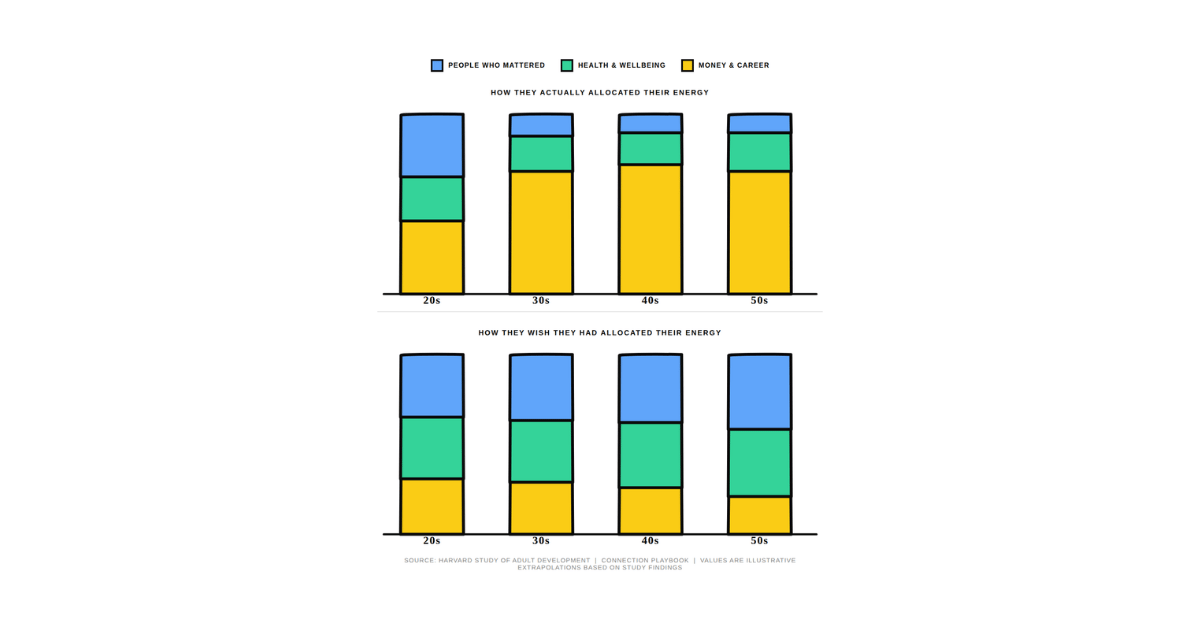
I created two charts based on the study's findings to illustrate what this actually looks like across a lifetime.
Take a look:
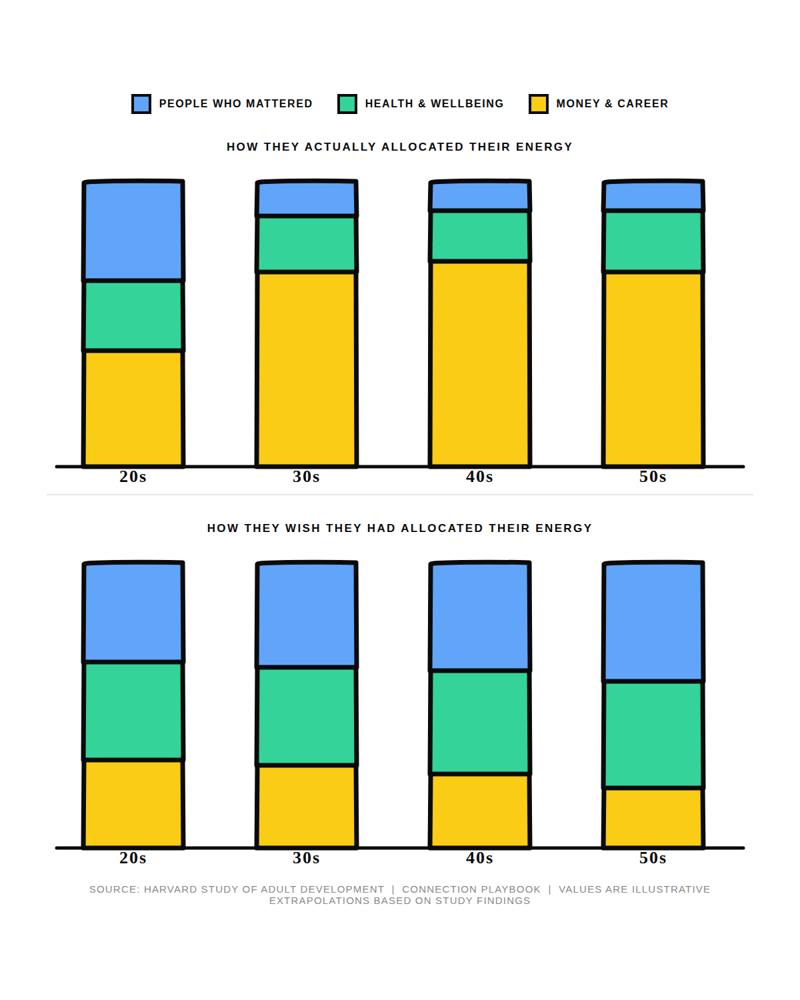
The top chart shows how most people actually allocated their energy across their 20s, 30s, 40s, and 50s. Money and career dominate every single decade. People who mattered get whatever is left over. And health sits somewhere in between, quietly neglected until it demands attention.
The bottom chart shows how the same people, looking back, wished they had lived.
The inversion is striking. In hindsight, people who mattered rises to the top in almost every decade. Money and career shrinks to the smallest portion. Health and wellbeing gets significantly more attention than it received the first time around.
Look at the 50s column in particular. By that decade, the people in the study overwhelmingly wished they had been pouring energy into relationships and health, not chasing more career milestones. But in the top chart? Career is still eating up the biggest share well into their 50s.
That gap between the two charts is where regret lives.
I know this gap well because I lived in it.
I started a business in my early 20s. Worked 10 to 12 hour days for years. My coworkers became my only real social circle, not necessarily because I chose them as friends but because they were the only people I saw. My wife and kids got whatever energy was left at the end of the day, which honestly wasn't much.
I told myself it was temporary. That I was building something. That the sacrifice would be worth it when things settled down.
As it turned out, things never settled down. There was always another milestone, another product launch. And somewhere along the way, the temporary sacrifice became the lasting reality.
What did it cost me? Relationships I can't fully recover. Time with my family I can't get back. And I spent years ignoring my own health because I was "too busy."
I didn't see the gap between those two charts while I was living it. I only saw it looking back.
Why we keep falling into this trap
Waldinger himself addressed this in a talk at Harvard. He said that people tend to focus on money and achievements because they're measurable. We can track a salary increase, count our steps on the managerial ladder, or watch a portfolio grow.
But relationships? They change all the time. They can't be measured the same way. And because of that, we deprioritize them. We pour energy into the things that give us a visible return and neglect the things that give us an invisible one.
The study found that people who were most satisfied in their relationships at age 50 were the healthiest at age 80. The most connected people outlasted the wealthiest and the most accomplished.
Waldinger put it plainly:
Loneliness kills. It's as powerful as smoking or alcoholism.
And yet, we keep optimizing for the wrong things.
The part that gives me hope
The researchers found something else that matters…
It's never too late.
People in the study who had struggled with relationships for decades sometimes turned things around in their 50s, 60s, even 70s. They reconnected with old friends. They built new communities from nothing.
Waldinger said, "Old dogs can learn new tricks. We have all these instances where people find the unexpected as they get older. People who are sure they're never going to have decent relationships. Close friends find them. People find love for the first time in their seventies and eighties. We have the data."
That's the thing about those two charts. The gap between them is real. But it doesn't have to be permanent. Every decade is a new bar on the graph. You get to decide how the next one looks.
Something to sit with this week
Look at those charts again. Which decade are you in right now? And does the top chart look uncomfortably familiar?
If it does, you're not alone. Most of us are living the top chart while knowing, somewhere in the back of our minds, that we’d be better off living the bottom one.
The study participants didn't get a second chance. But you're reading this now. Which means you still have time to close the gap.
Maybe that starts with something small this week. A text to someone you've been meaning to reach out to. Or just an evening with your phone put away and a conversation that goes a little deeper than "I'm fine, just busy."
The data is clear. The people who mattered were always the answer. Most of us just figure it out too late.
If this resonated, share it with someone who needs to see these charts. And if you're new here, I write about adult friendship every week because I think it's the most important thing many of us are quietly neglecting. Stick around.