A post I shared yesterday is making the rounds, so I want to dig into it a little deeper here.
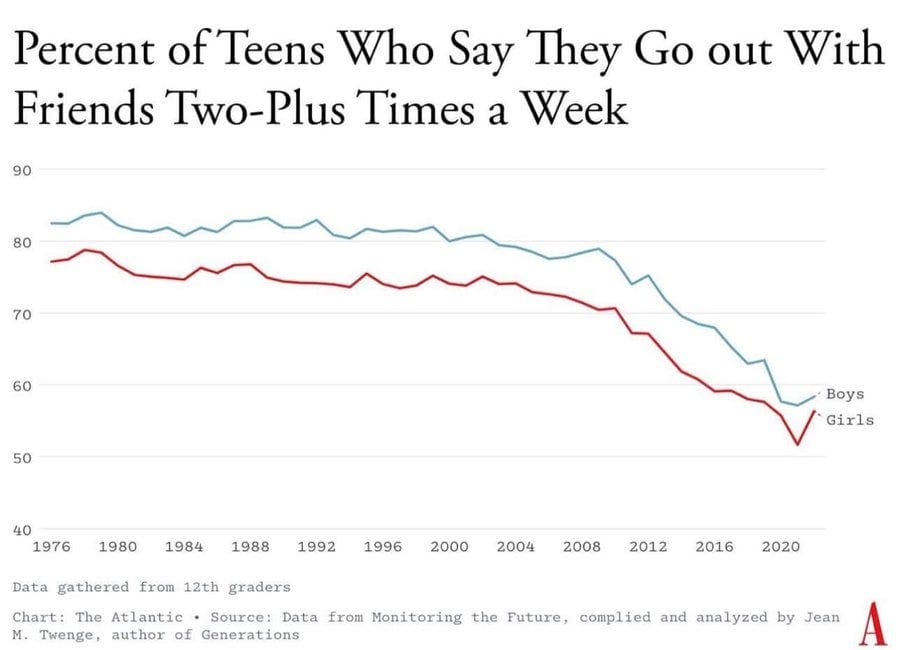
Teen hangouts dropped off a cliff after 2012. Those teens are now adults in their late 20s and 30s wondering why they have no close friends. We keep treating the loneliness epidemic like it came out of nowhere. It didn't. We just weren't paying attention when it started. Chart
View the post by Chris Carey on X
The chart comes from Jean Twenge’s data, tracked through the Monitoring the Future survey, which has been following American teens since the mid-1970s. It shows the percentage of 12th graders who say they hang out with friends two or more times a week.
For about three decades, that number barely moved. Boys hovered around 80-85%. Girls were close behind. Then, around 2012, it fell off a cliff. By the most recent data, both lines had dropped dramatically, with girls falling the furthest.
2012.
The year smartphone ownership crossed the 50% mark in the U.S. The year Facebook bought Instagram. The year social media went from something teens did sometimes to something they did constantly.
I’m not here to rehash the screen time debate. What I want to talk about is what happened next.
Those teens are now in their late 20s and 30s. They’re the ones sitting in apartments on Friday nights wondering why adult friendship feels so impossibly hard. They’re the ones who have 800 followers and no one to call when life inevitably throws them a curve ball.
And here’s what I keep coming back to: we talk about the loneliness epidemic like it showed up out of nowhere. Like one day everyone just woke up isolated. But that chart tells a different story. It tells us this started over a decade ago, with a generation of teenagers who stopped practicing one of the most important skills for building connection: spending unstructured time together, in person, with no agenda.
Think about what hanging out with friends actually teaches you. How to read a room. How to sit with awkward silence until it becomes comfortable. How to navigate a disagreement without unfollowing someone. How to be boring together, which is where most real intimacy actually lives.
These aren’t things you learn from a screen. They’re things you learn from showing up, repeatedly, in the same physical space as another person. Research from the University of Kansas found that it takes roughly 50 hours of time together to move from acquaintance to casual friend. 90 hours to become a real friend. And more than 200 hours to develop a close friendship. That’s not screen time. That’s face time. Hanging out, joking around, catching up about life.
Previous generations accumulated those hours almost by accident. You rode bikes to your friend’s house. You sat on porches. You drove around with nowhere to go. The infrastructure of friendship was baked into daily life.
When that infrastructure collapsed for an entire generation of teenagers, they didn’t just miss out on hanging out. They missed out on the repetitions. The muscle memory. The thousands of micro-interactions that teach you how to build and maintain a relationship with another human being.
So now we’ve got a whole cohort of adults who are smart, accomplished, and genuinely good people... who feel like they’re failing at something everyone else seems to find easy. And most of them think the problem is them. That they’re too awkward, too busy, or too far gone.
They’re not. They just never got the practice.
This is actually the part that gives me hope. Because if the problem is a skill gap rather than a character flaw, skills can be learned. At any age. It just requires something that feels deeply uncomfortable for people who grew up in the age of optimization: it requires inefficiency. It requires unstructured time. It requires showing up without a clear ROI.
It requires doing the thing that a generation of teenagers stopped doing in 2012.
A pattern worth noticing:
The people who struggle most with adult friendship aren’t lacking social skills. They’re lacking social reps. There’s a difference. Skills can be studied. Reps can only be earned by showing up.
Something to ask yourself:
When was the last time you spent unstructured time with a friend? If you can’t remember, perhaps it’s worth moving up your priority list?
Engineer a collision this week:
Text someone and say something like: “I don’t have a plan, but I’m free Thursday evening if you want to just hang out.” See what happens when you offer your time without packaging it into an event.
If you found this newsletter through a post I shared on X yesterday, welcome. I write about adult friendship every Tuesday because I think it's the most important thing most of us are neglecting. If this resonated, stick around. There's more where this came from.