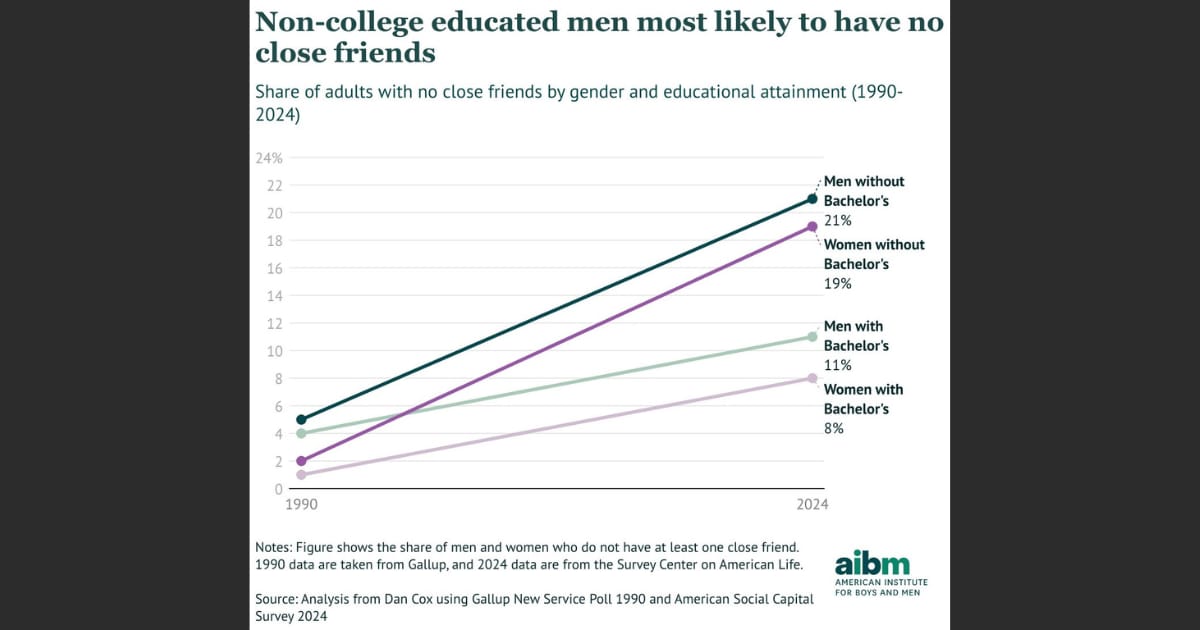
Last week I wrote about the spectrum of closeness in our friendships. This week I want to show you the chart that started that conversation.
The headline reads “non-college-educated men most likely to have no close friends.” And the conversation around this data has largely followed that framing. Male loneliness crisis. Men struggling to connect. Men falling behind.
But spend a minute with the actual lines, and a different story starts to emerge.
A pattern worth noticing
Look at the two lines without a bachelor’s degree.
Men without a bachelor’s degree: 21% report having no close friends. Women without a bachelor’s degree: 19%.
Two percentage points.
We’ve spent years treating this as a men’s problem. And the data does show that men without degrees sit at the top of the chart. But women without degrees are right behind them, and their trajectory has been steepening. In 1990, just 2% of women without a bachelor’s degree said they had no close friends. Today it’s nearly one in five.
If we keep framing this as only a male crisis, we’ll miss half the people who are struggling.
Now look at the chart again, but this time compare the top two lines to the bottom two.
Men without a degree: 21%. Men with a degree: 11%. Women without: 19%. Women with: 8%.
The gap between college-educated and non-college-educated adults is roughly double the gap between men and women in either group. And thirty years ago, the education gap barely existed. In 1990, nearly half of Americans with a high school degree or less reported having six or more close friends. Today that number is 17%.
Something structural changed. And it changed along class lines more than gender lines.
So what happened?
College doesn’t make you better at friendship. It just puts you in rooms where friendship happens.
This isn’t about intelligence or social skills. It’s about infrastructure. College gives you four years of repeated proximity with people your age who share your interests. And college graduates tend to carry that pattern of joining things into adulthood: sports leagues, professional groups, volunteer organizations.
But the institutions that used to serve that same function for everyone else have been slowly disappearing. Churches, unions, civic clubs, local organizations. These were the places where friendships formed without anyone having to be intentional about it. As those spaces eroded, the people who depended on them most lost their primary pathway to connection.
And here’s the part that should give all of us pause, regardless of what’s on our wall: those structures thin out for everyone eventually. You graduate. You move. You change jobs. You have kids. The things you used to show up to no longer make it on the calendar. And unless you find new ones, you might start wondering which line on the chart you belong to.
I’ve been sitting with this data for a couple weeks now, and the thing I keep coming back to is how this happens without much fanfare. Nobody announces that they’ve lost their friends. There’s no moment where you look around and think “this is the day my social life collapsed.” It’s just a slow fade. One less person you talk to. One more Friday where the couch wins.
I’ve been thinking about what I can do about it in my own life. One idea I keep coming back to: starting a bi-weekly get-together with a few friends. Something simple, maybe everyone shares music they’ve been listening to lately, we listen together, we talk. Low barrier, easy to repeat. The kind of thing that gives a conversation something to orbit around besides “how’s work?”
The research is pretty clear. Friendship isn’t built on grand gestures. It’s built on showing up to the same place, with the same people, over and over again.
If the structures that used to make that easy are disappearing, maybe the move is to start building our own.